
Okay, okay, I know…with that featured image, I just broke my own cardinal rule of not depicting the Big Bang as an explosion.
I did pick that image for a reason, though.
We first covered the Big Bang waaaay back in the beginning of May. Our exploration then was a bit surface-level — enough to begin to build our understanding of cosmology, but not a complete picture.
Then, at the end of July, we revisited the Big Bang and expanded upon it…and we discovered that we had indeed missed a crucial part of the story.
(That’s why I chose the featured image — but that’s spoilers!)
In this post, we’ll unite those discoveries and cover the Big Bang as we understand it today, all in a nutshell.
Let’s start by turning back the clock — all the way back to 13.8 billion years ago, at the very instant the Big Bang occurred.

Now, this bit is critical:
At this earliest moment, the entire universe is the Big Bang.
The Big Bang occurred everywhere. It refers to a moment in time, at the very beginning, when the entire universe was scrunched together.
And then, suddenly, the universe began to stretch apart.
So, what happened next?
If you read (and remember) my post on the universe’s first moments, this part will be familiar. 10-6 seconds (one millionth of a second) after the Big Bang, the universe was a matter-antimatter and photon soup —

Wait! No! Stop!
Remember in our revisit of the Big Bang, when I said we were missing part of the story?
Rewind — back to ground zero.
At the moment of the Big Bang, the four fundamental forces of nature — gravity, the electromagnetic force, the strong force, and the weak force — were unified as a single, overarching force.

Now, let the clock run forward. Stop at 10-36 seconds.
Okay, quick aside for those of you who are as bad at decimals and powers of ten as I am. The more zeros behind the decimal, the smaller the number. The “power” — in this case, -36 — counts how many decimal places we have.
So, 10-36 is a way smaller number than 10-6.
In fact, 10-36 is 100 decillionths of a second…which is a math word I just learned tonight!
Anyway.
At 10-36 seconds, the electroweak force and the strong force disconnected from one another.
The result?
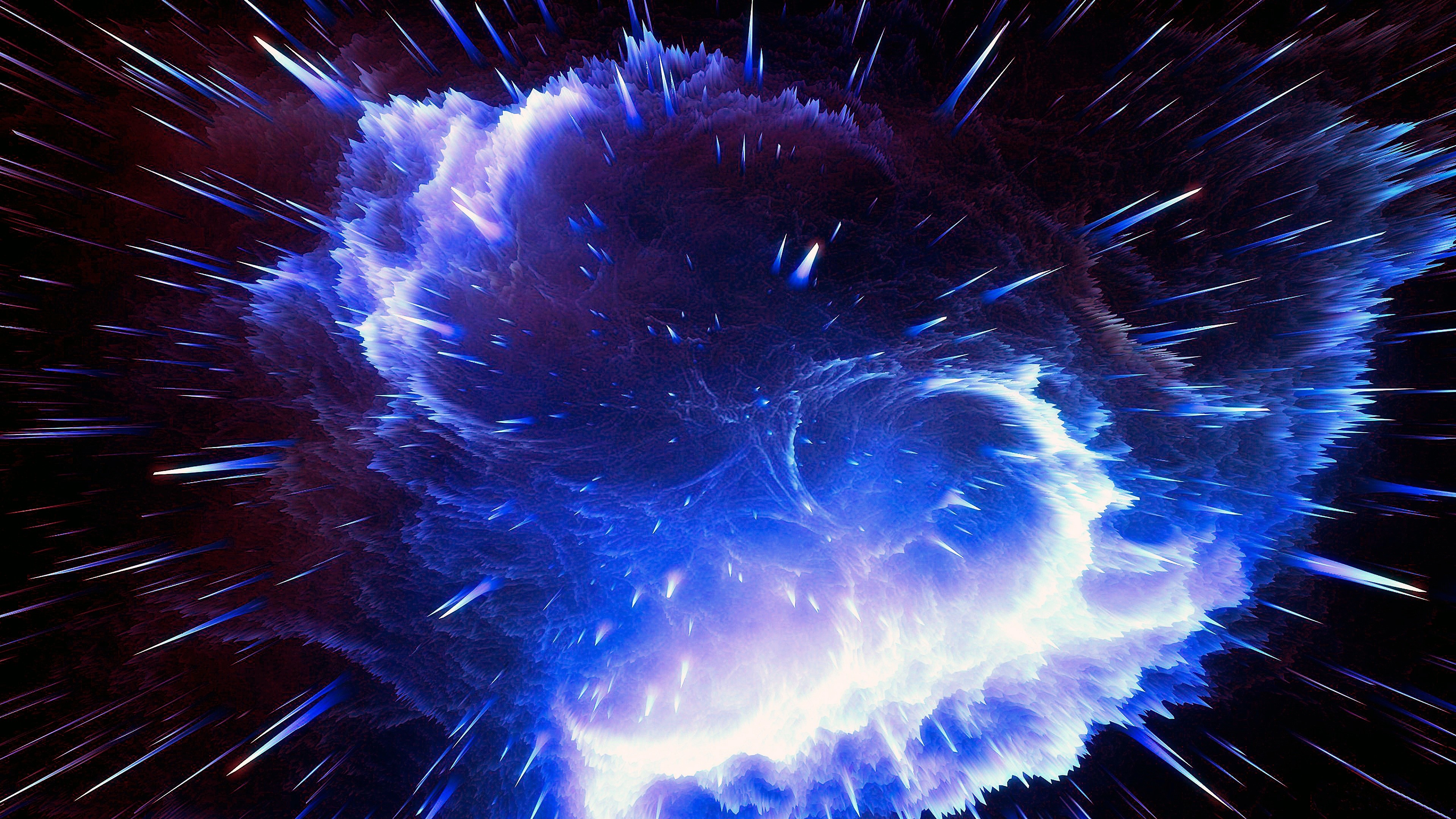
Told you I used that featured image for a reason.
Still, I would be remiss not to clarify that this was not a localized explosion any more than the Big Bang itself was a localized explosion. This separation of two fundamental forces simply released absolute crap tons of energy.
(Can I coin that as a new unit of measurement — the absolute crap ton?)
That release of energy caused the universe to expand suddenly and violently…in a moment that cosmologists call inflation.
Inflation lasted only 10-32 seconds. But in that infinitesimally short span of time, the universe inflated in size by…drumroll…

A factor of at least 1050.
(Again, for those like me who are bad at powers of ten — if the power is positive, then it counts zeros in front of the decimal. As in, a giant multiple of 10, not a tiny fraction.)
The end of inflation leaves us at 1.0001 x 10⁻³² seconds past ground zero. Now let’s let the clock run forward again…
…to 10-6 seconds.
Now we can get back to talking about that matter-antimatter and photon soup.
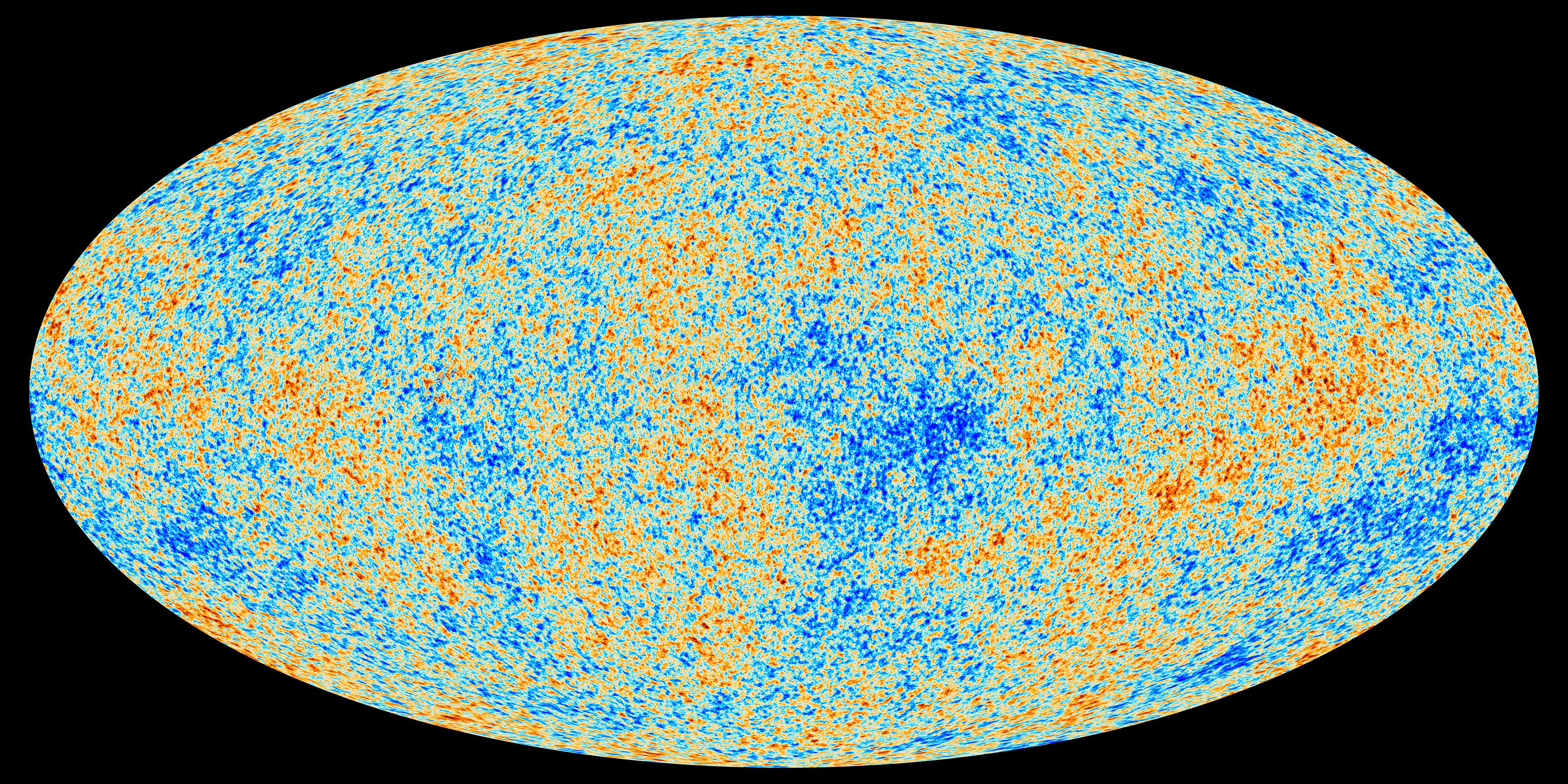
At 10-6 seconds, the universe was filled with high-energy photons with temperatures of 20 trillion K (kelvins). Which, by the way, is ridiculously hot.
At these temperatures, thanks to E=mc2, photons are able to convert into a matter-antimatter pair of particles. (More on how that works here.)
But this radiation was also very dense. So, when the photons converted to matter-antimatter pairs, these particles were packed pretty close together.
They were bound to collide. And when a matter-antimatter pair meet, they annihilate each other…
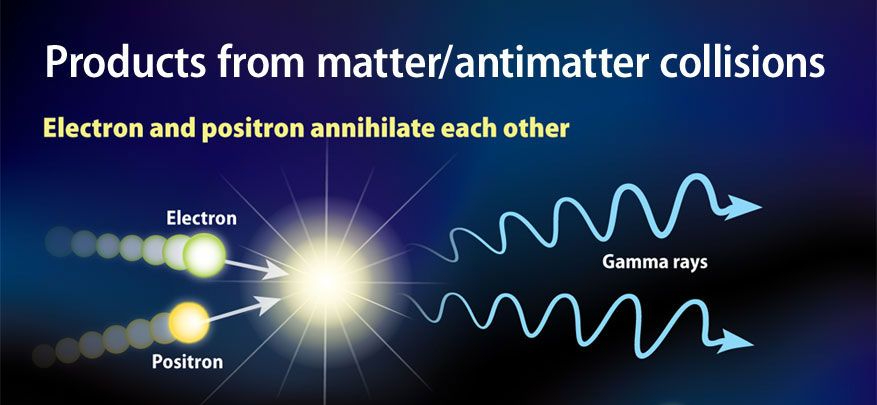
…and produce two gamma rays, via E=mc2.
So, this early universe was a soup of energy, flickering between particles and photons and back again.
But remember, it’s only been 10-6 seconds since the beginning of time.
During this fraction of a second, the universe continued to expand. This would have reduced the temperature of the radiation and, consequently, the energy of the photons.
Now, here’s the thing: the more massive the particle, the more energy it takes to convert photons into that particle.
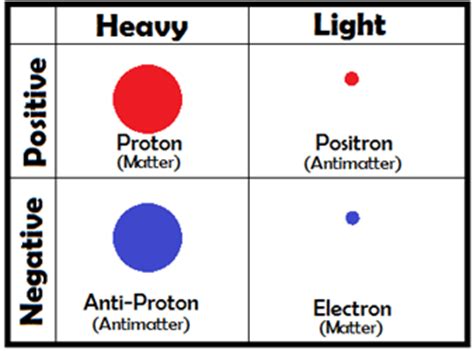
At 10-5 seconds, the universe’s temperature would’ve dropped from 20 trillion K to “only” about 2 trillion K.
The universe’s energy budget would now be too low to produce proton-antiproton pairs or neutron-antineutron pairs.
But the universe was still dense, particles crammed close together. The existing particles would’ve combined with their antiparticles, annihilated one another, and converted their mass to photons — and stayed that way.
Electrons and their antimatter counterpart, positrons, are about 1800 times less massive than protons and neutrons. So they would have remained within the universe’s energy budget…
…for another 60 seconds.
After that point, even electrons and positrons would have annihilated one another and converted to photons for good.
So…why is there any matter in the universe?
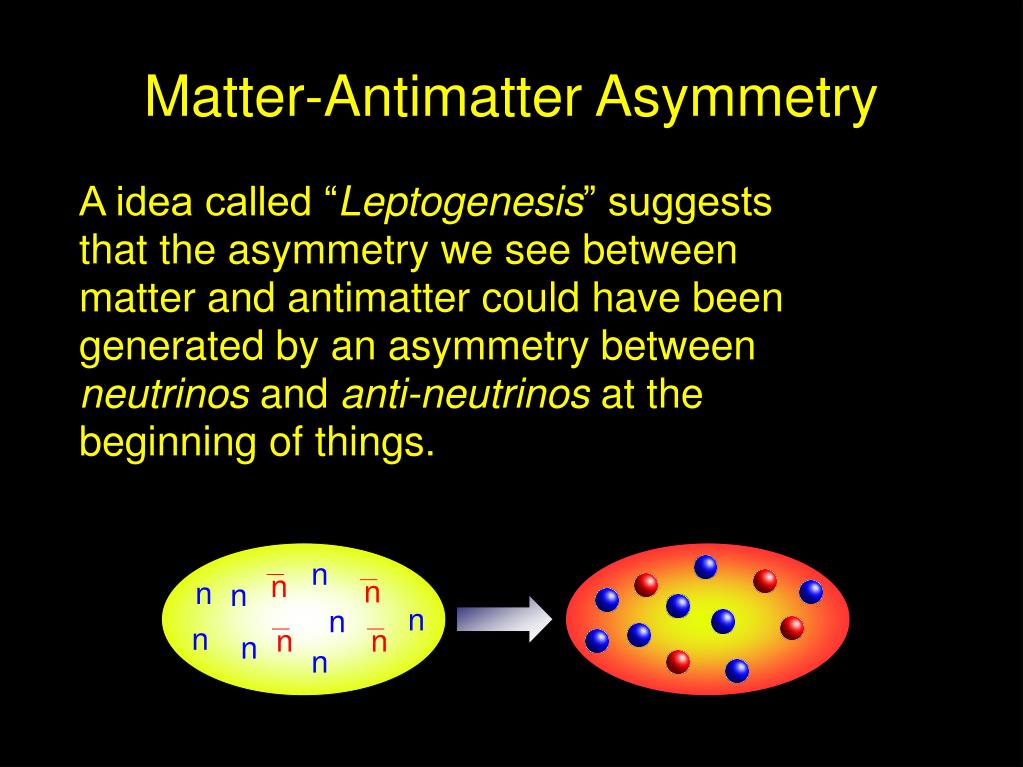
Truth be told, it’s one of the most vexing questions in cosmology. All matter-antimatter pairs should have been annihilated, leaving only photons.
But for some reason we haven’t figured out, the Big Bang produced a little bit more matter than antimatter. For every billion matter-antimatter pairs, one particle of matter survived with no antiparticle to annihilate it.
In case anyone’s watching the clock, we are now at 60.00001 seconds past ground zero.
60 seconds into the universe’s current 13.8-billion-year lifespan.
That’s the big bang theory for you — this time, in its entirety. But next up, we’ll lay out the universe’s entire timeline, from beginning to end.
(And after that, I’ll treat you to a present-day, human-lifetime timeline — of cosmological discovery, from the days of classical astronomy to modern cosmology!)










Did I blow your mind? 😉