apparent visual magnitude
-
Cosmology Demystified
That has got to be the single strangest post title I’ve ever written. Of all the whacky branches of science out there, cosmology almost takes the cake — second only, I think, to the downright trippy world of quantum mechanics.…
-

How Big and Bright are Galaxies?
The brightest galaxy in our night sky is the Andromeda Galaxy, our nearest intergalactic neighbor. Hey…notice we’re talking about intergalactic neighbors now? 😀 In most of the posts on this blog, we’ve talked about interstellar neighbors, interstellar space, etc. But…
-

How Far Away are Galaxies?
Well, I’ll give you a spoiler: they’re ridiculously far away. Let’s consider for a moment what a light-year actually means. It sounds like a unit of time, but it’s actually the distance that light travels in one Earth year. Think…
-
Star Types Demystified
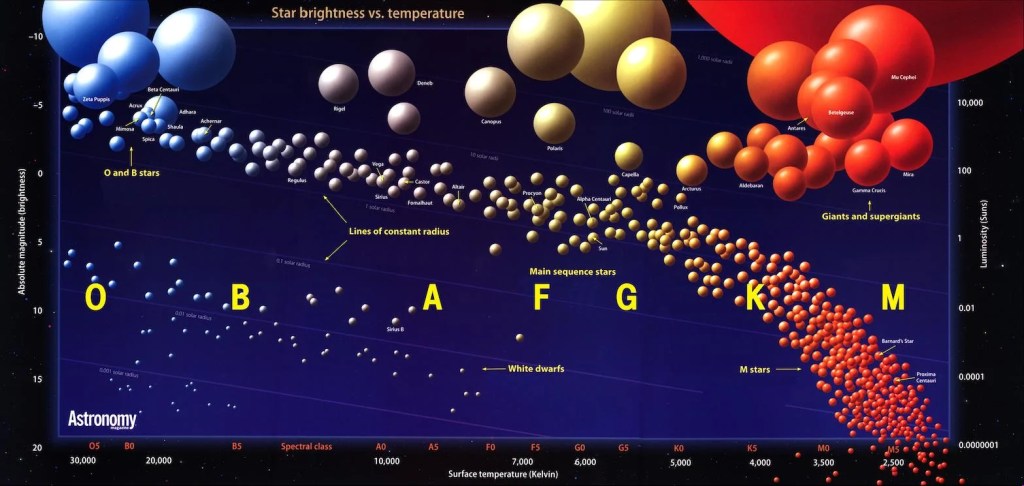
By now, I’ve introduced you to a lot of different ways to classify stars. Months ago, I talked about the different spectral classes — O, B, A, F, G, K, and M. Even before that, I told you about apparent visual…
-
How Far Are the Stars?
Stars don’t look small because they’re really the size of pinholes in a blanket. The smallest are the size of Earth. The largest have 128,865,170 times Earth’s diameter. They look small in the sky because they’re distant. It’s for the same…
-

The Starlight We Can’t See
Find yourself a dark, unpolluted night sky on a clear night free of clouds, and you are very likely to look up into the heavens and see a sight quite like this. It’s what we see of the Milky Way,…
-
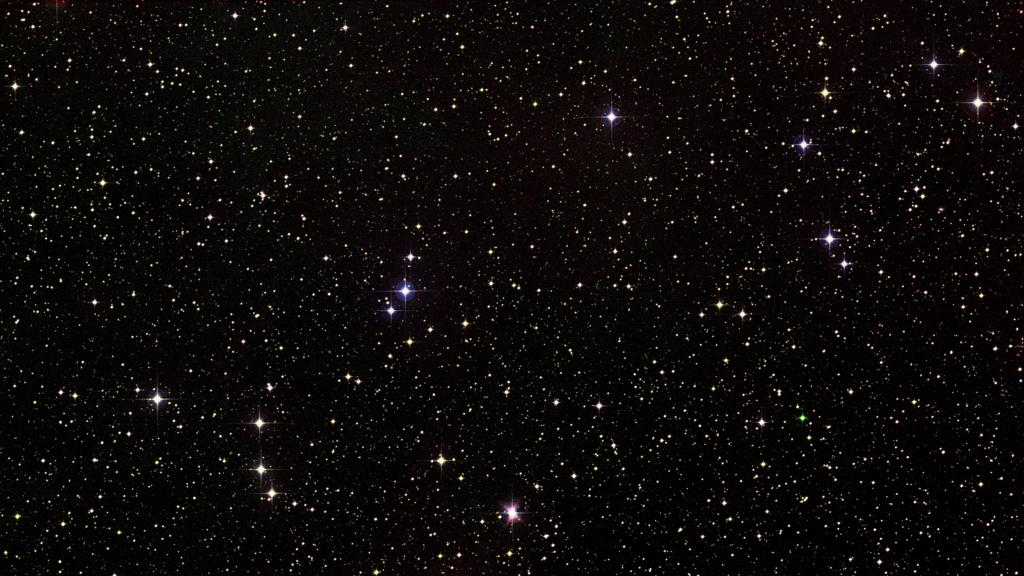
The True Brightness of Stars
Have you ever looked up at the night sky and noticed that while relatively bright stars outline the constellations, there are numerous other stars that are almost too faint to see with the naked eye? If you ever noticed this,…
-

Stars and Proper Motion
Recognize this constellation? Well, at the time stamp of about 2000 AD (CE), I think you will. It’s one of the most famous constellations in the night sky. Well, technically, it’s not a constellation at all. It’s an asterism — a…
-

Stars: Naming and Brightness
Meet Pegasus, and the constellations surrounding it. As I said in my last post, constellations are just regions of space. Yes, they are named after mythical beasts and ancient queens, but for scientific purposes, all that matters are the regions…
