Compact Objects: Neutron Stars and Black Holes
-

Stellar Evolution Demystified
Whaddya know…after what seems like a geological age, we’re finally done with stellar evolution! And we’ve covered a truly ridiculous amount of information. We’ve covered a star’s relatively gentle, humble beginnings within the collapsing cores of giant molecular clouds (or…
-

How to Find a Black Hole
Okay, good question. How the heck do you find an object that emits no radiation? Astronomers find — and study — just about everything in the universe using the radiation it emits or reflects. So…what happens when the object we’re…
-

Black Holes: What the Movies Get Wrong
Any of you recognize this? To those who don’t, it probably looks like a pretty unimpressive, blurry ring. In fact, this is the first ever image of a black hole, taken with an interferometer the size of the Earth. If…
-

What is a Black Hole, Really?
If you’re a sci-fi fan, you’ve probably seen these in movies. And I’m guessing you’ve heard a lot about them in pop culture. The problem is, pop culture and movies don’t do a very good job of describing black holes.…
-

Unique Neutron Stars
Neutron stars — the compact remains of massive stars that have gone supernova — are some of the most extreme objects in the universe, narrowly beaten by black holes (and, as we’ll talk about in future posts, active galaxies and…
-
Binary Neutron Stars
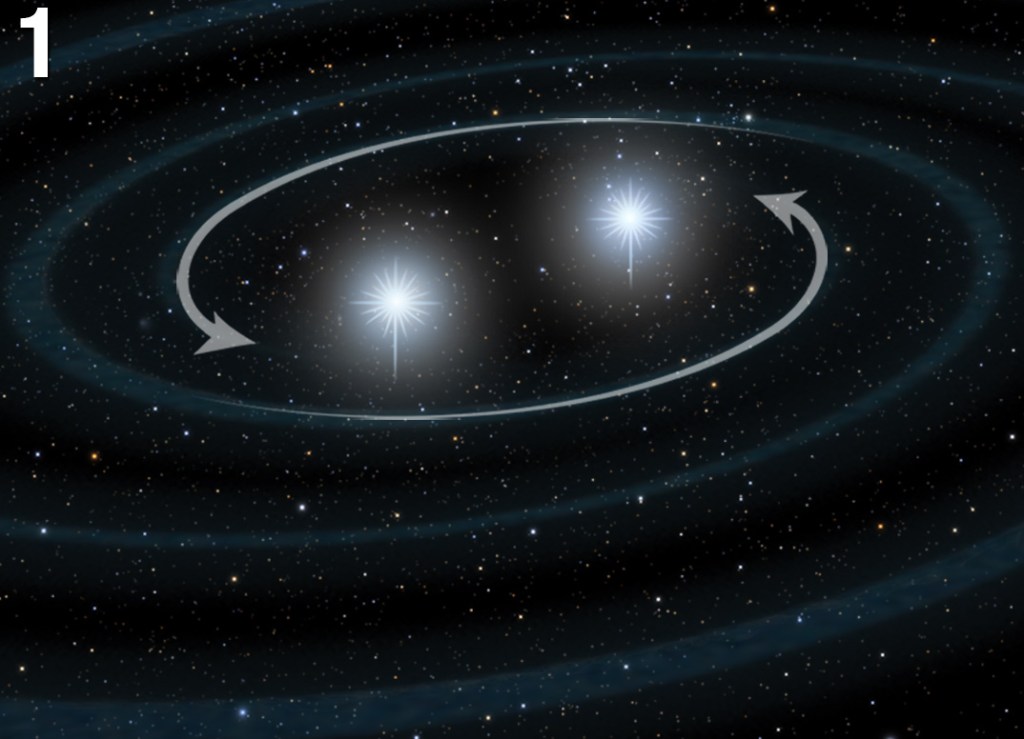
Way back when we spent a number of posts surveying the stars, we covered binary systems. These are star systems that contain multiple stars. Imagine if our sun had a companion, and two stars rose and set in our sky…
-
Pulsars as Neutron Stars
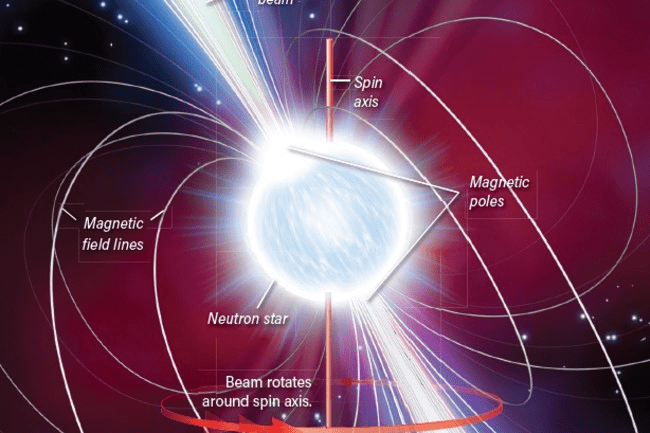
For those of you who missed my last couple of posts, allow me to introduce the neutron star: a stellar remnant similar to a white dwarf, but much denser, so dense that its protons and electrons have combined to form…
-

What is a Pulsar?
Imagine you’re observing the sky with a radio telescope. Observing the faintest, lowest-energy photons the universe has to offer is your specialty. You study interstellar dust clouds, protostars, and lots more. One day, though, something interesting pops up in your…
-
Why Neutron Stars Should Exist
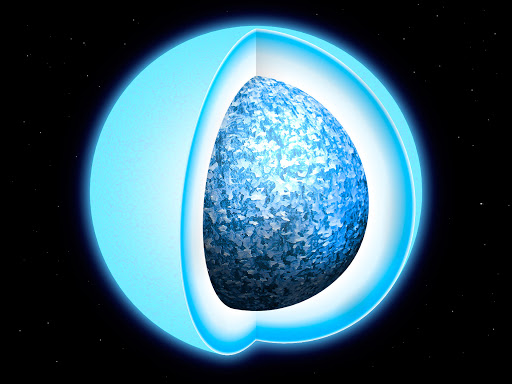
Above is a theoretical rendering of a white dwarf, the collapsed husk of a low-mass or medium-mass star. Interestingly enough, these strange cosmic objects — which begin their existence as intensely hot balls of carbon the size of the Earth…
