
orbital velocity
-

What About Pluto?
In my last post, we explored the two types of planets: terrestrial (Mercury, Venus, Earth, and Mars) and Jovian (Jupiter, Saturn, Uranus, and Neptune). Pluto was conspicuously absent from the lineup…especially considering that we took a peek at the moon.…
-

How Massive are Galaxies?
If you needed to measure the mass of, say, a brick — or some other Earthly object — you could just set it on a scale. (Yes, scales measure mass, not weight.) With galaxies, it’s not so easy! I don’t…
-

How Massive is the Milky Way?
Over centuries of philosophy and research, through the times of the classical astronomers to Galileo’s observations of the Milky Way, humanity’s understanding of our universe has evolved from a simple model of the sun and planets to a vast wheel…
-
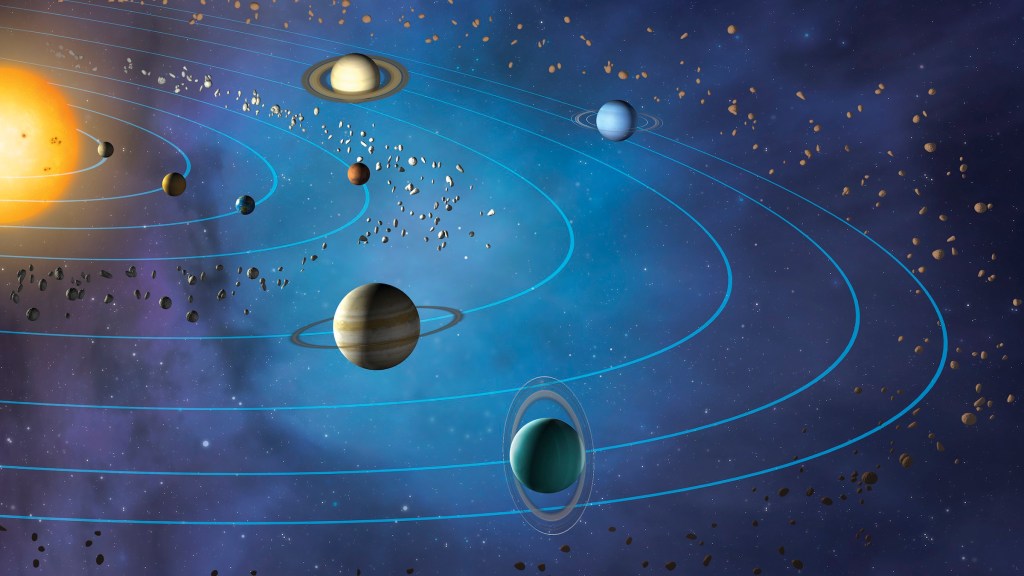
How Orbits Work
Since Aristotle’s time over 2000 years ago, we have accepted that the moon orbits the Earth. We didn’t always know why, and we didn’t always accept this for the right reasons. We used to assume that it happened just because…
