
radio astronomy
-
What the Heck is a Quasar?
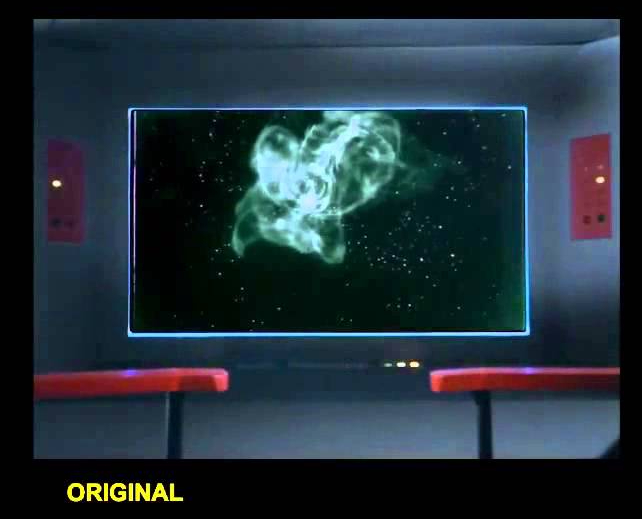
I’ll give you a hint: this is not an image of a quasar. This image is from a first-season Star Trek: The Original Series episode, “The Galileo Seven” — the original footage, before it was remastered (and before astronomers had…
-
Exploring the Milky Way’s Nucleus
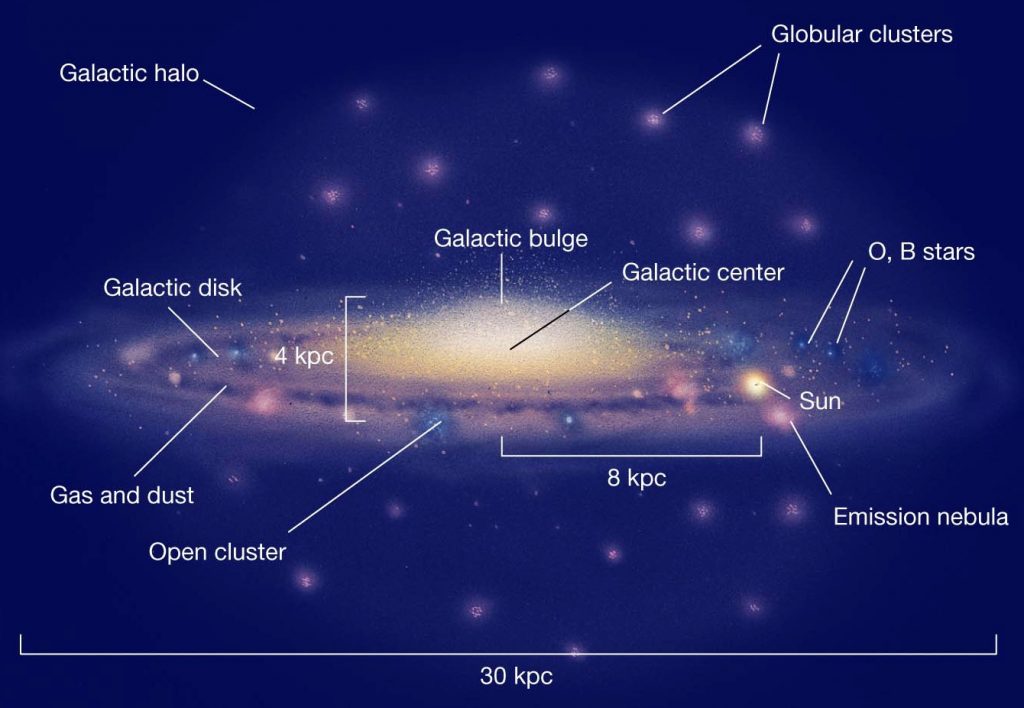
Here is an edge-on illustration of our Milky Way Galaxy. (Keep in mind that the disk actually stretches quite a bit farther out from the budge than is apparent in this illustration. Proportionally, its full diameter makes its thickness less…
-

What is a Pulsar?
Imagine you’re observing the sky with a radio telescope. Observing the faintest, lowest-energy photons the universe has to offer is your specialty. You study interstellar dust clouds, protostars, and lots more. One day, though, something interesting pops up in your…
-

Radio Astronomy: Advantages
Whoa…what’s this thing? It’s a radio telescope, the largest in the world. It’s so huge that a normal support system can’t support its weight. So it’s basically suspended between three mountaintops. It’s 300 m across, which is 1000 feet. It’s…
-

Radio Astronomy: Limitations
Astronomy is a labor of love, and radio astronomy is no different. As I covered in my last post, radio astronomy deals with the longest wavelengths of the electromagnetic spectrum (a spectrum that includes visible light). Radio waves are not sound…
-

Radio Astronomy
Ever seen one of these before? Yeah, it’s a bit bigger than your average radio antenna. That’s because its job isn’t to direct radio signals to your house. It’s a radio telescope, and its job is to collect as many radio…
-

Interferometry
Imagine you have an image like one of these. This object is faint and faraway, so you can’t make out much more detail. You know that other stars like it — closer, brighter stars — have looked like this and…
