
Have you heard of the Big Bang?
I still remember the first time I heard about it. I was little; I can’t remember if I’d fallen in love with astronomy yet. But I do remember sitting in my living room, surrounded by my dad’s scientific journals and magazines.
One cover page caught my eye. There was a full-page illustration of a young student standing before an old-fashioned blackboard, writing over and over, “I believe in the Big Bang.”
I had no idea back then what this “Big Bang” was.
And as it turns out, it’s not what most people think…
There’s a common misconception about the Big Bang: that it was an explosion at a specific location, and the universe has spread out from that explosion like a shockwave.
This is not the case.
Many graphics depicting the expansion of the universe depict the Big Bang as a starburst-like explosion:

While I appreciate the artistic license, I think such representations perpetuate that misconception.
In fact, the term “Big Bang” itself was never meant to accurately describe the event — it was invented by early critics to make fun of the Big Bang hypothesis. It ended up catching on, but it’s misleading.
The Big Bang was not an explosion. And it’s impossible to point to any location in the universe and say, “The Big Bang happened there.”
Why?
First, we’d better get on the same page…

I chose to use this particular graphic because, unlike many similar ones, it does not depict the Big Bang as an explosion.
If you’ve ever looked up the Big Bang, expansion of the universe, dark energy, cosmology in general, or anything of the sort, there’s a good chance you’ve seen a graphic like this. But what does it actually mean?
Look at this graphic as sort of a 3D cylinder. Each circular “slice” of the cylinder represents the entire physical state of the universe at one specific point in time.
…kinda like this, but without the initial bit being an explosion:
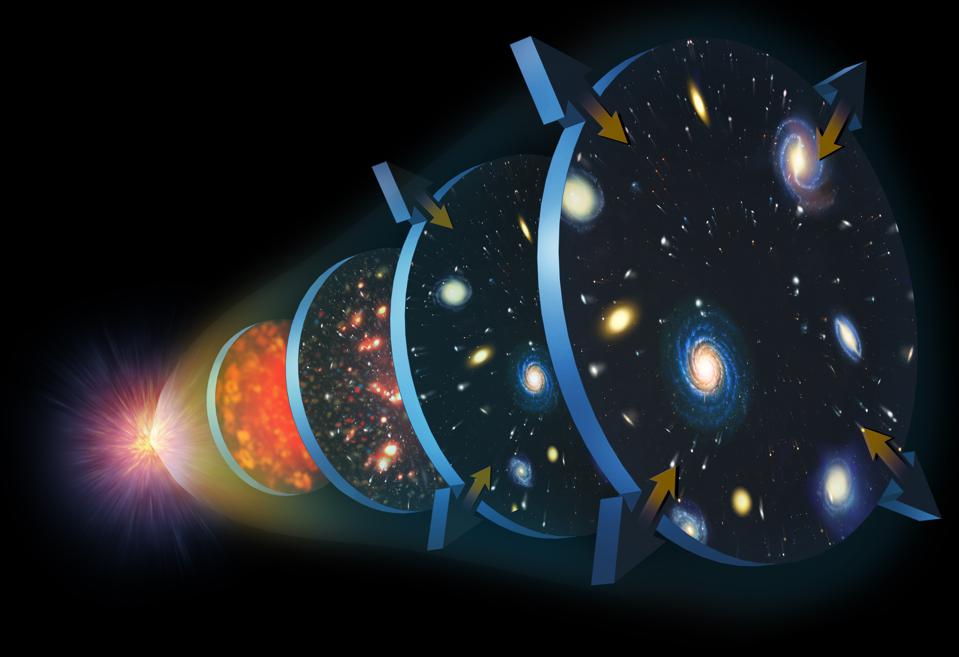
For example, on the right, the graphic is labeled “Today.” So, that rightmost slice of the cylinder shows the universe’s current state.
Look leftward on the graphic, one “slice” at a time. What you’re doing now is essentially “turning back the clock.” You’re looking incrementally further and further into the past. Notice that the cylinder shrinks a bit as you go: each circular slice gets smaller and smaller.
This represents the expansion of the universe. As we turn back the clock, we see this expansion in reverse. Slices representing times further and further back in time show a smaller and smaller universe.
As we keep turning back the clock, galaxies remain stationary while the distances between them shrink.
Now, look to the far left of the cosmological cylinder, where you see the “Big Bang” label.
Here’s the crux: that label represents an entire circular slice of the cylinder, at the very beginning of time.
At this earliest moment, the entire universe is the Big Bang.
The Big Bang occurred everywhere. It refers to a moment in time, at the very beginning, when the entire universe was scrunched together.
And then, suddenly, the universe began to stretch apart. (In fact, my textbook judges “big stretch” a more accurate term than “big bang.”)
So, how long ago was this?
We can quickly estimate how far back the Big Bang occurred simply by measuring the present-day separation between galaxies.

We know the galaxies’ positions now; we know that they started scrunched together. We can find their speed from their cosmological redshifts based on the Hubble Law. From there, it’s a simple matter of finding the time they took to move from Point A to Point B.
(For those of you familiar with cosmic inflation: yes, I acknowledge that this velocity did not remain constant. It works as a rough estimate. And for those of you who are now wondering what I’m talking about…we’ll get to that later on in our cosmology unit! 😉 )
The separation between galaxies varies. Instead of doing the calculation individually for every galaxy in the whole dang sky, we can use the Hubble constant, represented as H0. The Hubble constant, calculated using measurements of the distances to galaxies, summarizes the separation between all galaxies.
Alrighty, let’s break the Hubble constant down…
First: units. It has units of km/s/Mpc, or kilometers per second per megaparsec. Kilometers per second (km/s) is a speed; km/s/Mpc is a speed divided by a distance.
If we take the reciprocal of H0 (just flip the fraction over), we then have a distance divided by a speed.
Voila: we now have a time.

Now we convert megaparsecs to kilometers so that the distance units cancel out, leaving us with an age in seconds. And, of course, the number of seconds since the universe’s beginning is going to be an absurdly massive number, so we convert that to years.
We now have the Hubble time:

Note that we still have H0 as a variable because all we have done is convert the units into years. If we plug in a value for H0, then we get an estimated age of the universe.
For now, we’ll use a value of H0 = 70 km/s/Mpc. Be aware, though, that this is a very rough estimate.
That yields a value of 1012/70 years, or roughly 14 billion years.
What does this mean?
If the expanding fabric of space is carrying galaxies apart from one another at roughly 70 km/s (the Hubble constant), then the time when they were all scrunched together (the Big Bang) was roughly 14 billion years ago.
Yup. That’s a lot of years.
And here’s the craziest bit. You know how earlier, we were “turning back the clock,” imagining the universe’s expansion in reverse?

Thanks to a very convenient mechanic of light, we actually can look back in time.
Because light travels at a set speed (in a vacuum), the light we observe from the most distant reaches of the universe left its source billions of years ago. As I’ve described before, this is called look-back time.
We can’t actually observe the Big Bang itself, for reasons we’ll explore in posts coming up. But we can see all the way back to a time shortly after the Big Bang, when stars and galaxies had yet to form, and hot gas dominated the universe.
Some of you may have an idea where I’m headed with this: the cosmic microwave background radiation.
But that’s a story for next week!










Leave a reply to Emma Cancel reply