
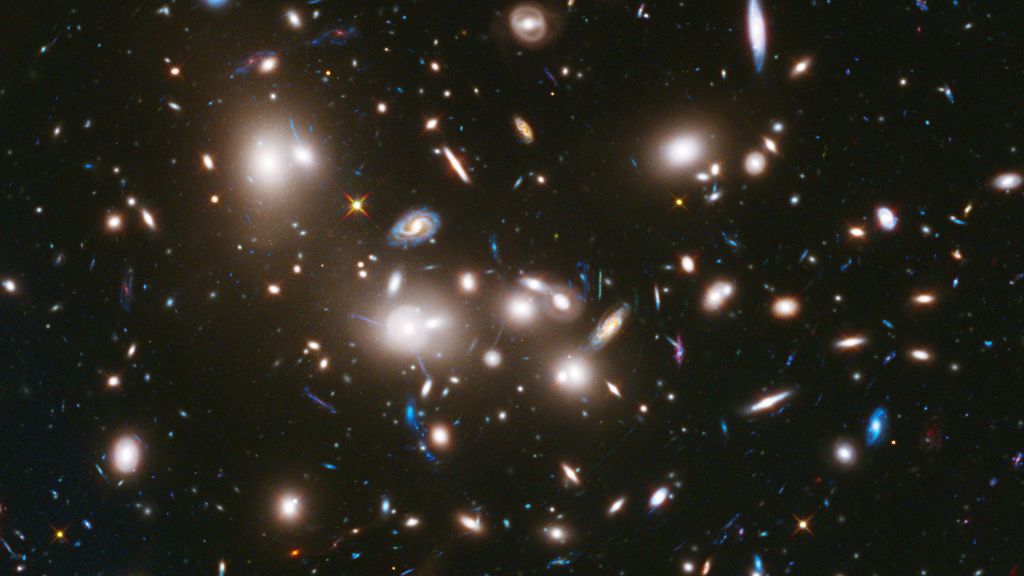
When we look out into the sky, we see a universe filled with galaxies.
Galaxies are the second-largest “structure” we’ve covered in depth on this blog. The largest so far have been galaxy clusters, which are just what the name implies: clusters of galaxies.
Just as solar systems are held together by the central star’s gravity, galaxies and galaxy clusters are held together by mutual gravitation. But there are structures even larger — clusters of clusters, called superclusters, and cosmically massive filaments — which are harder to explain.
They are certainly held together by gravity. That’s not the problem. The problem is why.
Here is a galaxy supercluster, for your viewing pleasure:
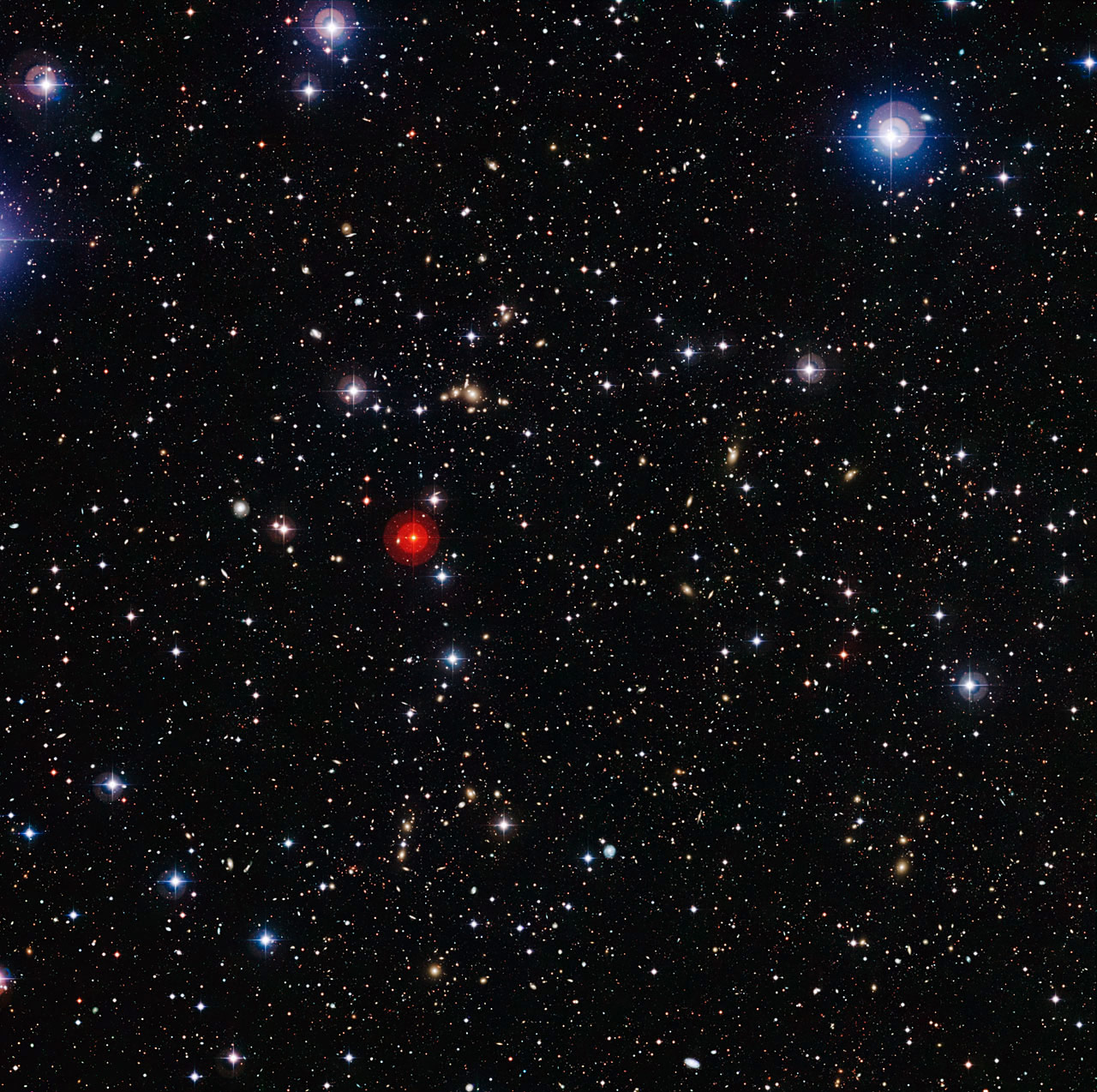
Wait a second…where are the galaxies?
Superclusters are extremely large structures, comprised of not just multiple galaxies, but multiple galaxy clusters. To get a detailed image of a galaxy, you need a close-up, magnified view; to capture an entire supercluster, you need an extremely wide-field image. You can’t get both at once.
I promise, there are individual galaxy clusters here — they’re just extremely zoomed-out. Here, I’ve marked them:
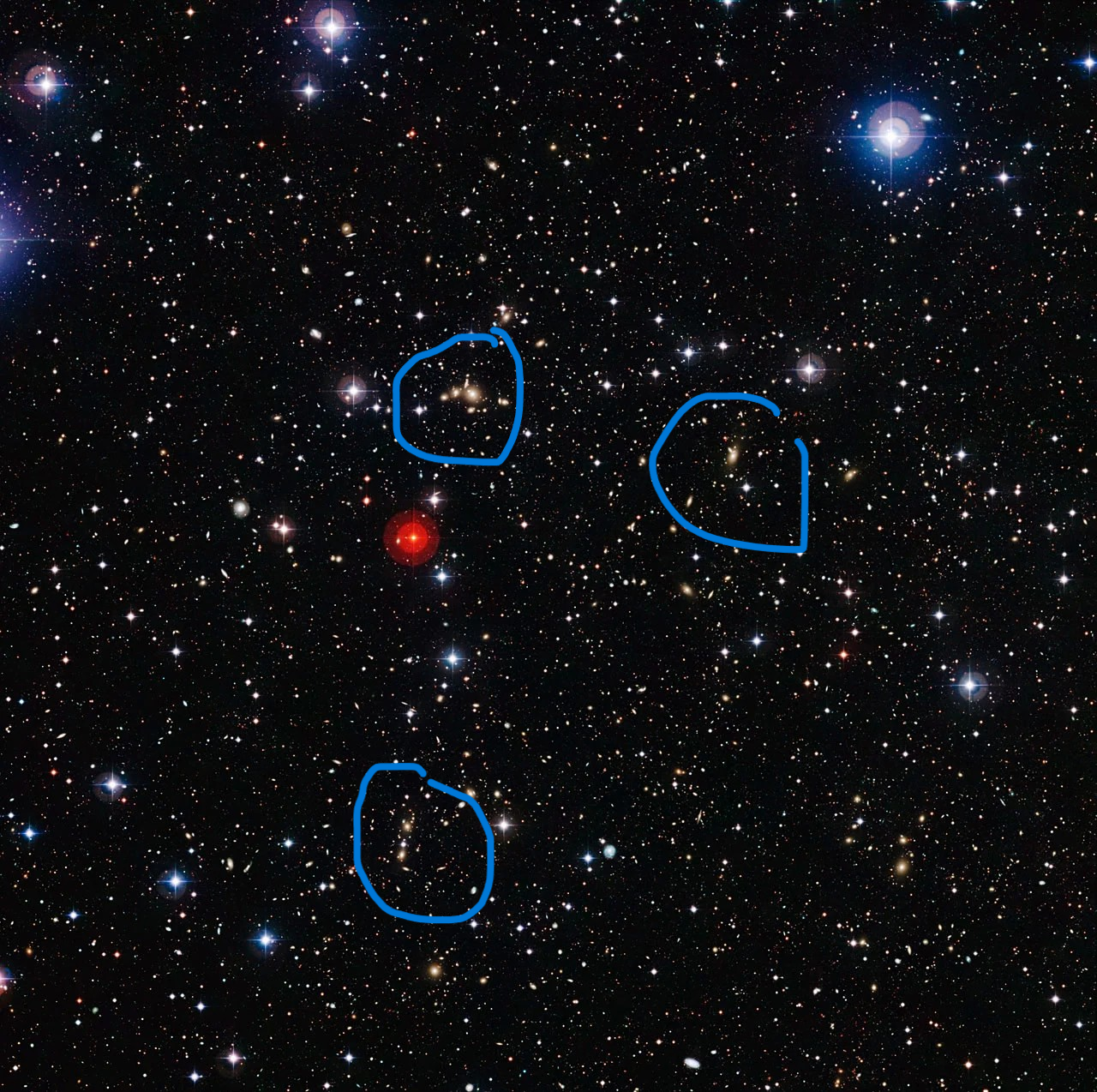
Most galaxy clusters are grouped into superclusters, including our own. (Our oh-so-imaginatively named home galaxy cluster, the “Local Group,” is part of the even more imaginatively named “Local Supercluster.”)
But structures get even bigger…
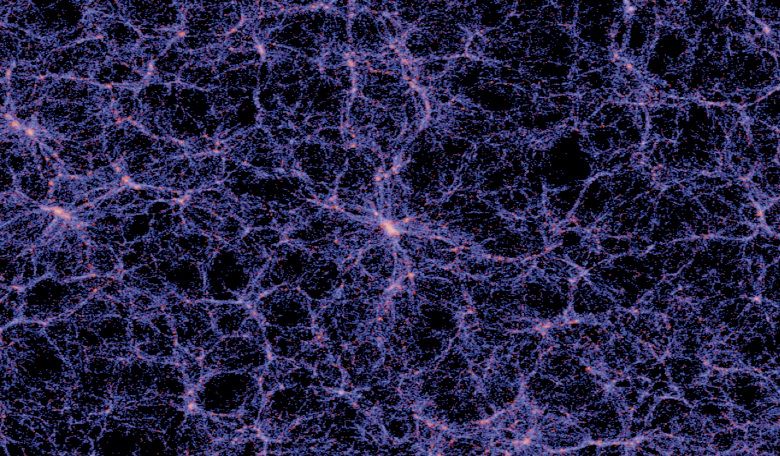
This is the most massive — and the biggest — structure in the universe.
(Massive and big don’t always go together, in astronomy; an interstellar dust cloud is much bigger than a star, for example, but not necessarily as massive.)
What the heck is this spiderweb-y thing, you ask?
These are filaments.
A single filament is comprised of many, many entire superclusters strung together in a long, narrow line, like string. And many, many filaments are woven together throughout the universe.
The space between filaments — known, quite creatively, as voids — are nearly empty of galaxies. These are the dark regions you see above.
Superclusters and filaments are together known as large-scale structure — and this structure is quite puzzling, because it shouldn’t exist.
Here’s why:
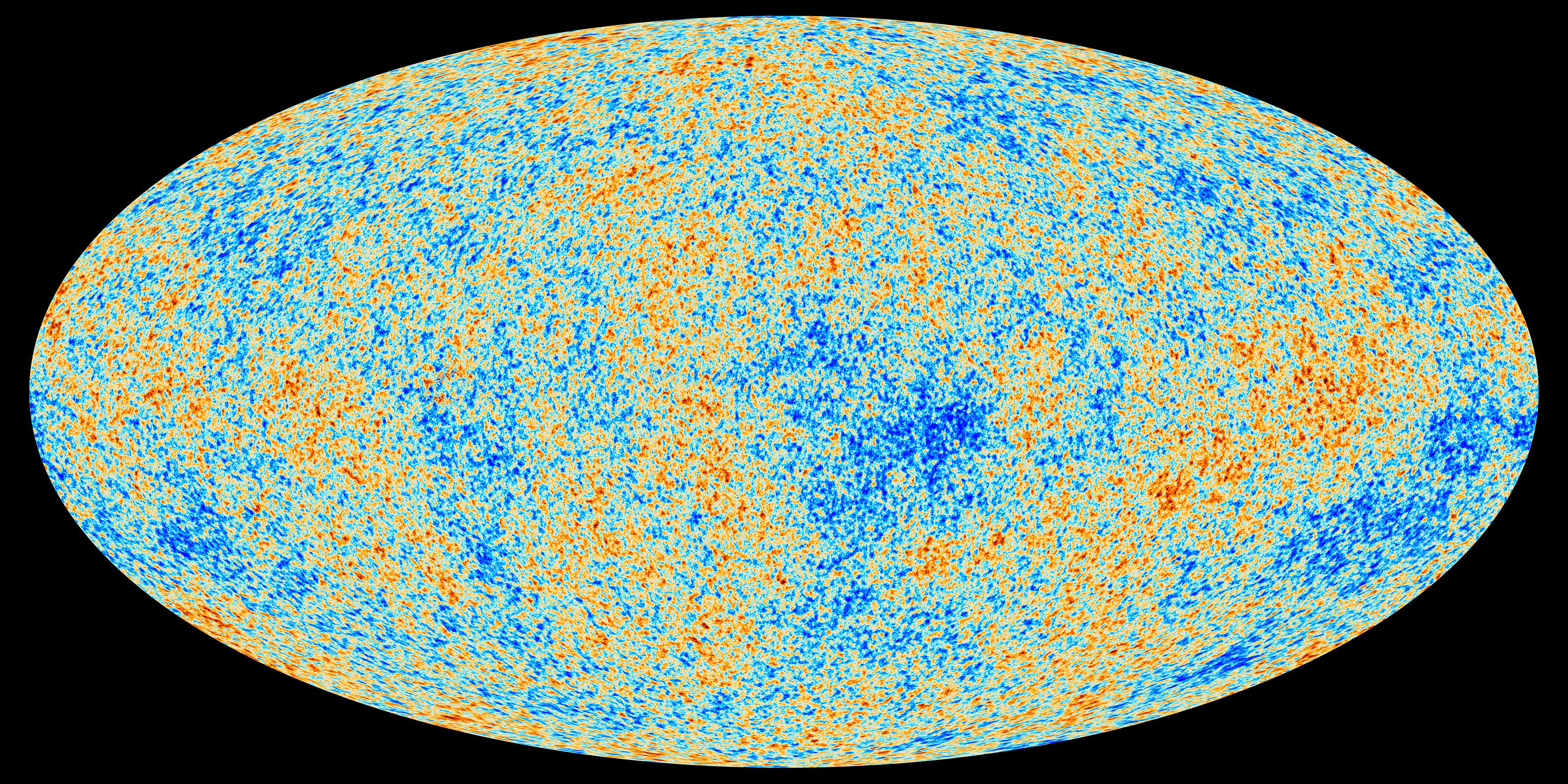
Remember the cosmic microwave background radiation (CMB)?
We first encountered the CMB when we explored how it was discovered. Most importantly, though, we took a glance when we covered the cosmological principle: the notion that, on large scales, the universe is both homogenous (uniform) and isotropic (the same in all directions).
In that post, we observed that the CMB appears to be extremely uniform — that is, broadly speaking, there aren’t major fluctuations in its appearance across the sky.
Why is this important?
Because the CMB is the afterglow from the Big Bang. It’s a relic from the time before recombination, when the first atoms formed about 400,000 years after the Big Bang.
It tells us that, in that earliest time in the universe’s history, the universe was very uniform overall. There weren’t large clumps of stuff; it was all spread out quite evenly.
And yet, the most distant structures — galaxies and the supermassive black holes we see as quasars — are seen less than 1 billion years after the Big Bang.

How could galaxies clump together from such uniform, evenly spread matter in such a cosmically short period of time?
The answer lies with something you may be familiar with: dark matter.
It’s hardly the first time I’ve mentioned dark matter on this blog. We first encountered it in our discussion of how to measure a galaxy’s mass, and we’ve come across it again and again since — most notably when we questioned whether dark matter was real. (It most likely is.)
In my last post, we measured the total density of mass in the universe, including dark matter, and we found that dark matter outweighs ordinary matter by a factor of 5 to 10.

Comparatively speaking, there isn’t much ordinary matter in the universe — known as baryonic matter. It has never been dense enough to begin clumping together under the force of its own gravity.
And in the beginning, radiation dominated the universe. It was far denser than baryonic matter, and it acted as a smoothing force, preventing matter’s attempts to clump.
But unlike baryonic matter, dark matter doesn’t interact with radiation. That’s why we can’t see it: we can see baryonic matter because of the way it reflects and emits light.
Radiation couldn’t dominate dark matter. The two don’t touch.
Dark matter also doesn’t interact with baryonic matter, or even with itself. It is totally free to do whatever it wants, with no input from other “materials” in the universe.
And there is one way that dark matter does influence baryonic matter. It’s how we were able to discover dark matter in the first place. It is able to gravitationally influence baryonic matter. (That’s why galaxies spin the way they do.)

Before baryonic matter could even begin to clump together, dark matter was already drawing together under its own gravity, forming into the long, spiderweb-y filaments we see today.
And as soon as baryonic matter began to dominate over radiation, it was drawn straight into that web like insect prey.
Well, I say straight…but I mean cosmically speaking. By human perception, this was a slow, gradual process. Matter started quite uniformly spread out, and over the course of almost a billion years, dark matter’s gravity began to pull it into its invisible web.

You know how hard it is to see a spiderweb? That’s kind of the point — insects get caught because they flew straight into something they couldn’t see. Strands of web have to catch the light just right to be visible.
Well, the universal web of dark matter is invisible, like a spiderweb. We see those strands when they “catch the light” — when baryonic matter, in the form of superclusters of galaxies, gets caught.
In this way, we can sort of indirectly “see” dark matter. And that lets us learn more about it.
In particular, we can choose between two hypothetical types of dark matter: the imaginatively named hot dark matter and cold dark matter.
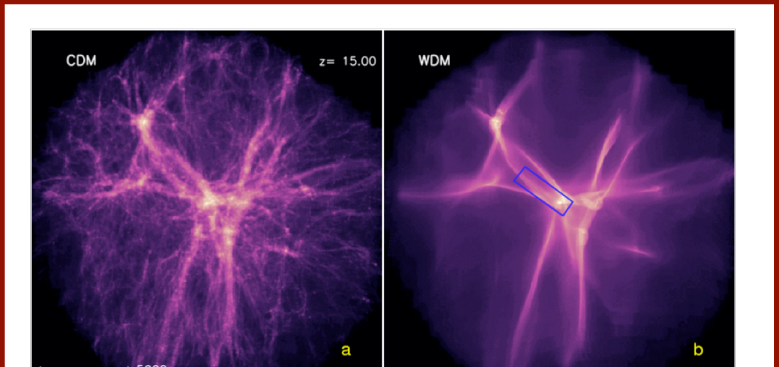
On the left, we see the filament structures that would form under the influence of cold dark matter. And on the right, we see the same for hot dark matter. (It’s abbreviated WDM, for “warm” dark matter; same difference.)
Don’t worry about the z = 15.00; that’s just a measurement of redshift, indicating that we’re looking super far back in time, toward the beginning of the universe.
In this case, “cold” and “hot” (or “warm,” as the case may be) have nothing to do with the actual temperature of the dark matter. It refers to the size of the particle.
Cold dark matter would be made up of more massive particles; the much lighter particles of hot dark matter would travel at relativistic speeds (close to the speed of light).
In theory, hot dark matter would cause structure in baryonic matter to form from the top down: that is, large filaments would form, and then separate into individual superclusters, and then into galaxy clusters, and then into galaxies.
Imagine it as like drawing a solid line and then erasing little sections to make it a dotted line, then erasing bits of the dots to make them into clusters of dots.

Models of hot dark matter, though, don’t match observations of actual filaments very well. Cold dark matter matches observations better.
Under the gravitational influence of cold dark matter, baryonic matter would form structure from the bottom up: galaxies would coalesce first, then galaxies would gravitate together into clusters, then clusters would gravitate together into superclusters, then superclusters would fall in line with the long, thin strings of dark matter to form filaments and voids.
Cold dark matter best matches what we see, so it’s probably the right kind of dark matter.
But that still leaves a million-dollar question…
Gravity usually causes matter to coalesce into spherical structures, or at the very least round structures.
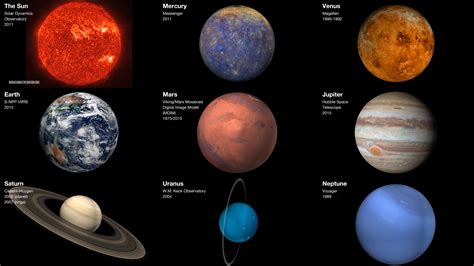
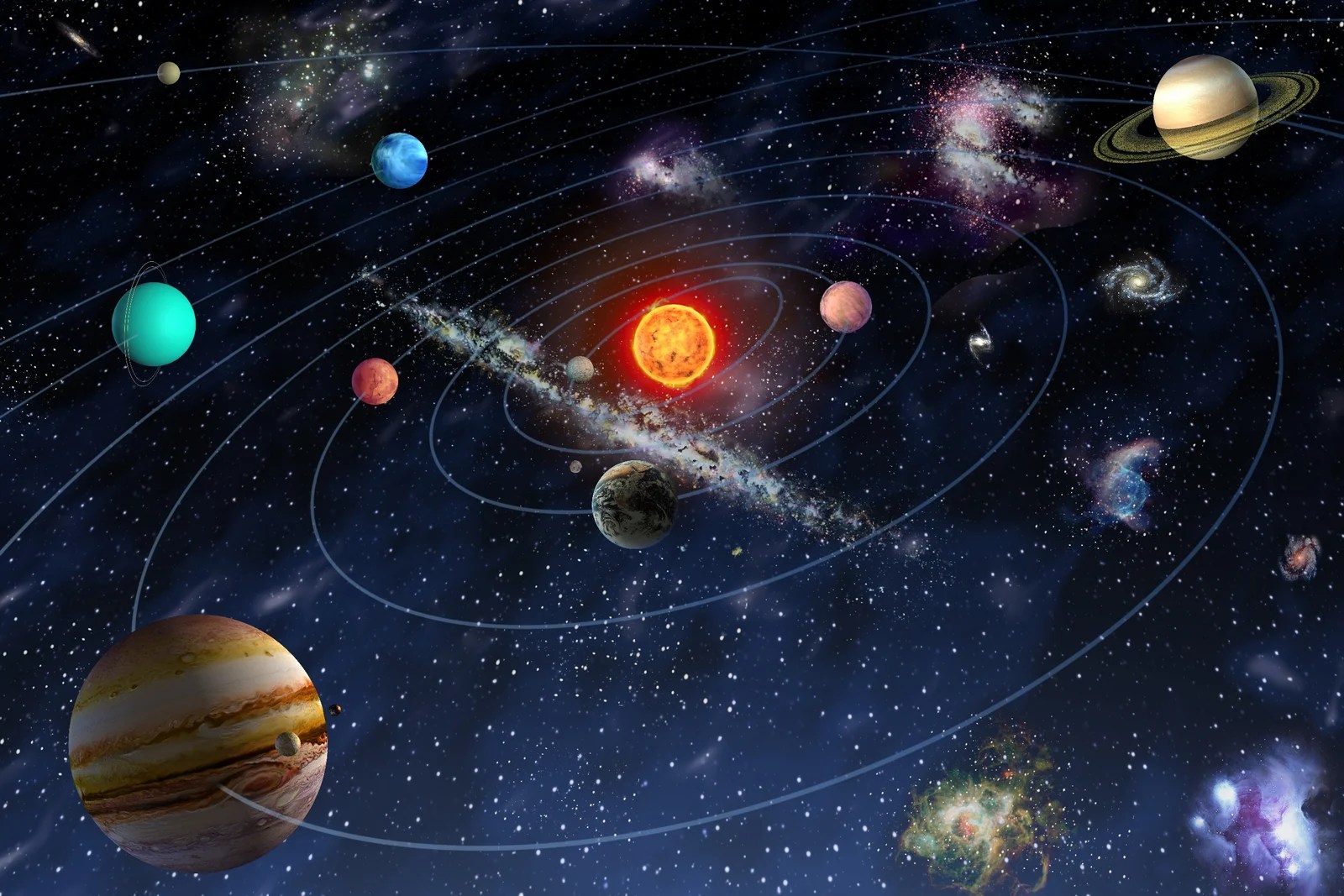
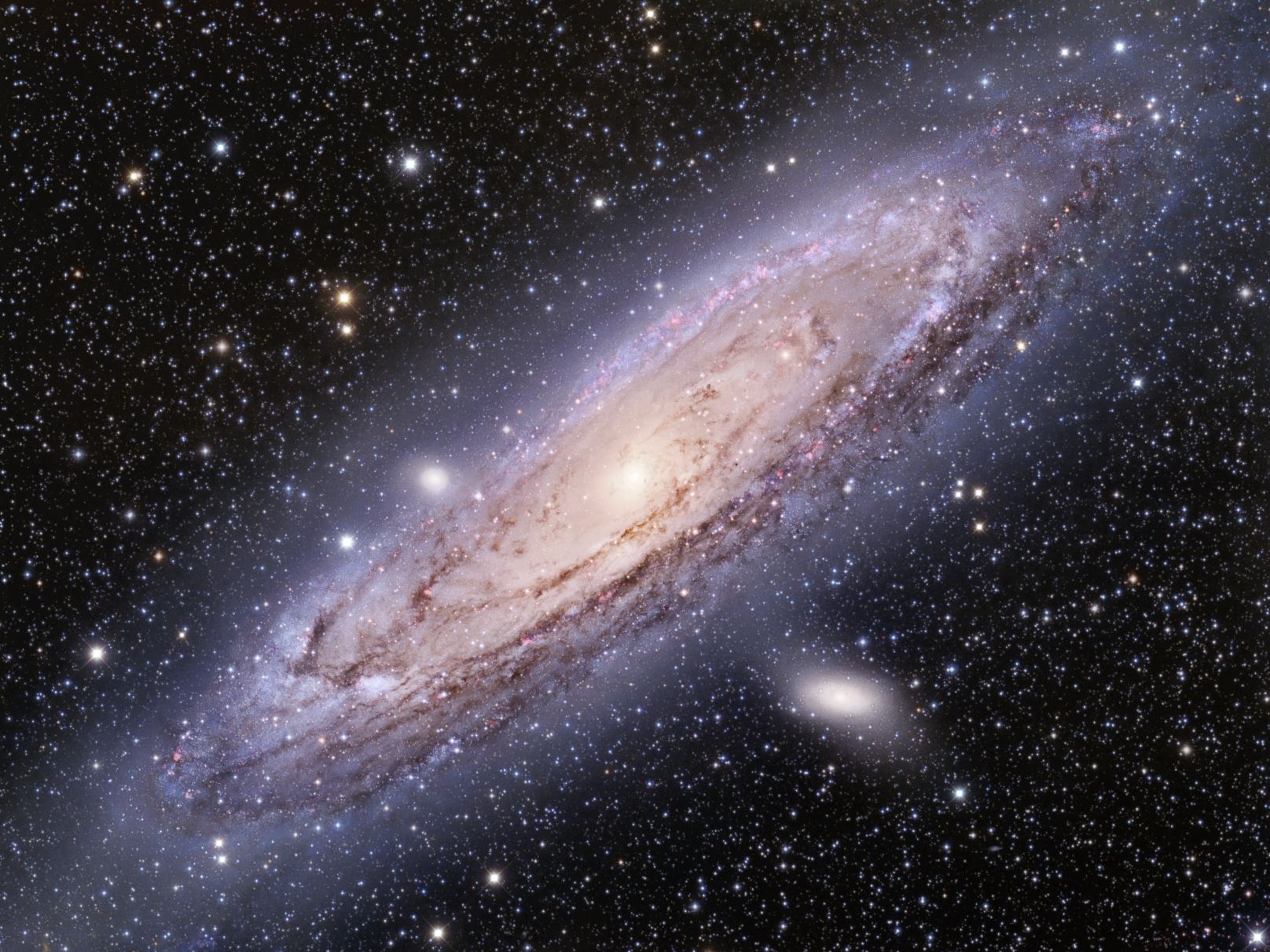
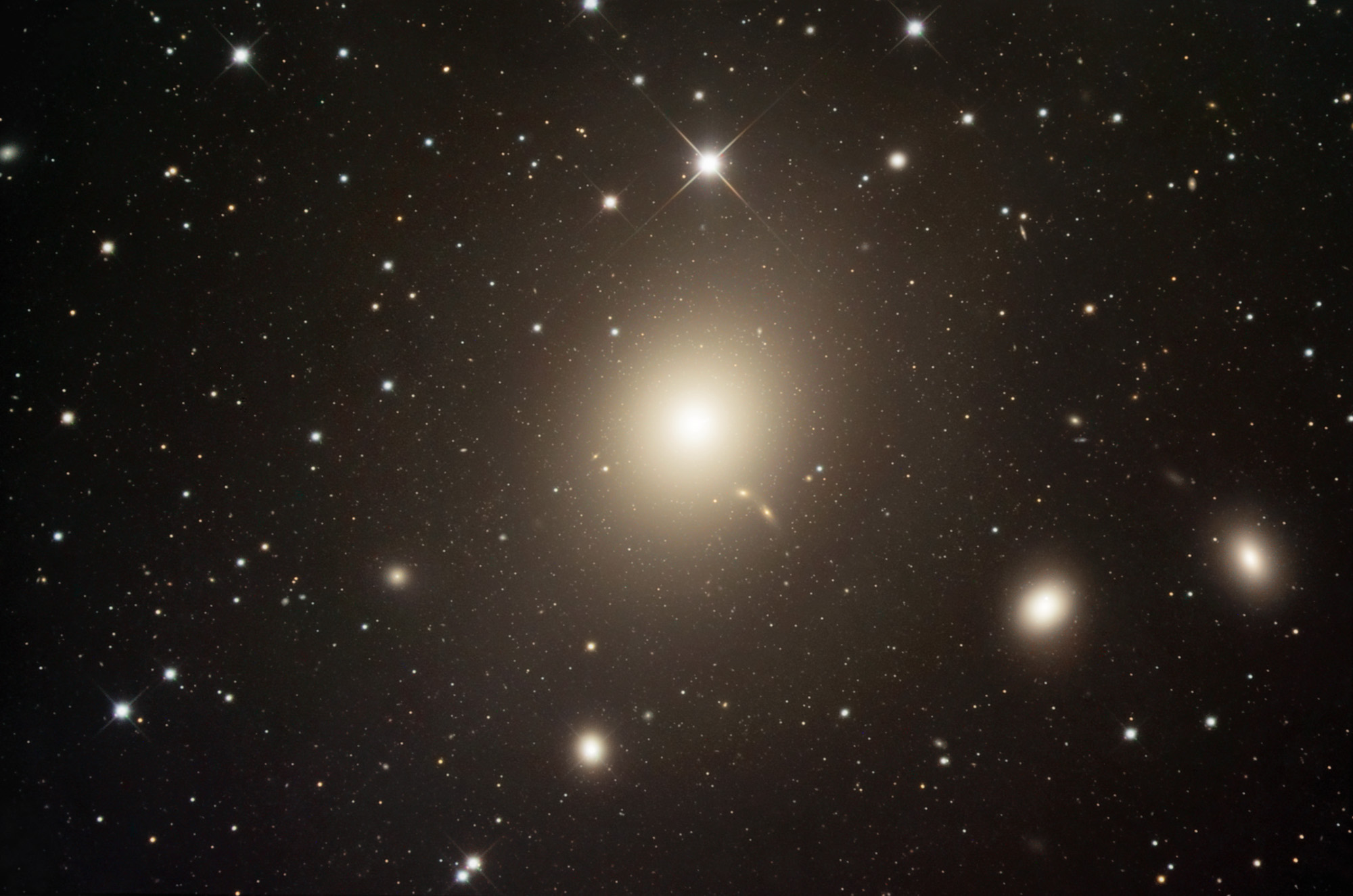
Planets are spherical. Solar systems are round disks. Galaxies come in the round, disk-shaped spirals and the spherical ellipticals. Irregularly shaped galaxies are a sign of tidal disturbances between galaxies.
Even galaxy clusters themselves follow blob-like patterns with a center of mass, and the same goes for superclusters.
So why the heck are filaments long and thin, like chains? Why would gravity cause dark matter to coalesce into such a structure? Gravity doesn’t usually make spiderwebs.
The answer may lie at the quantum level.
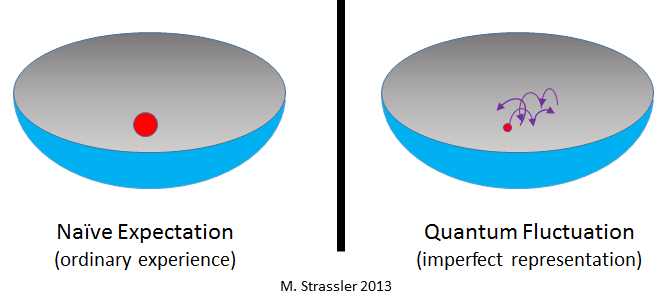
The whacky world of quantum mechanics dictates that the universe could never have been completely, perfectly smooth. Tiny quantum fluctuations would’ve existed.
When I talk about the quantum level, I mean fluctuations and imperfections smaller than even the smallest subatomic particles.
Mechanically, these fluctuations would’ve existed as something like bubbles of energy, forming and vanishing continuously. They would’ve started out small. But as the universe expanded, they would have been stretched out and magnified.
They’d still be subtle. But they’d be there.
These fluctuations could have resulted in subtle variations in gravitational fields, which would eventually give rise to filaments and the great voids between.
That is why we see the structures we do today — the massive superclusters, galaxy clusters, and galaxies themselves.
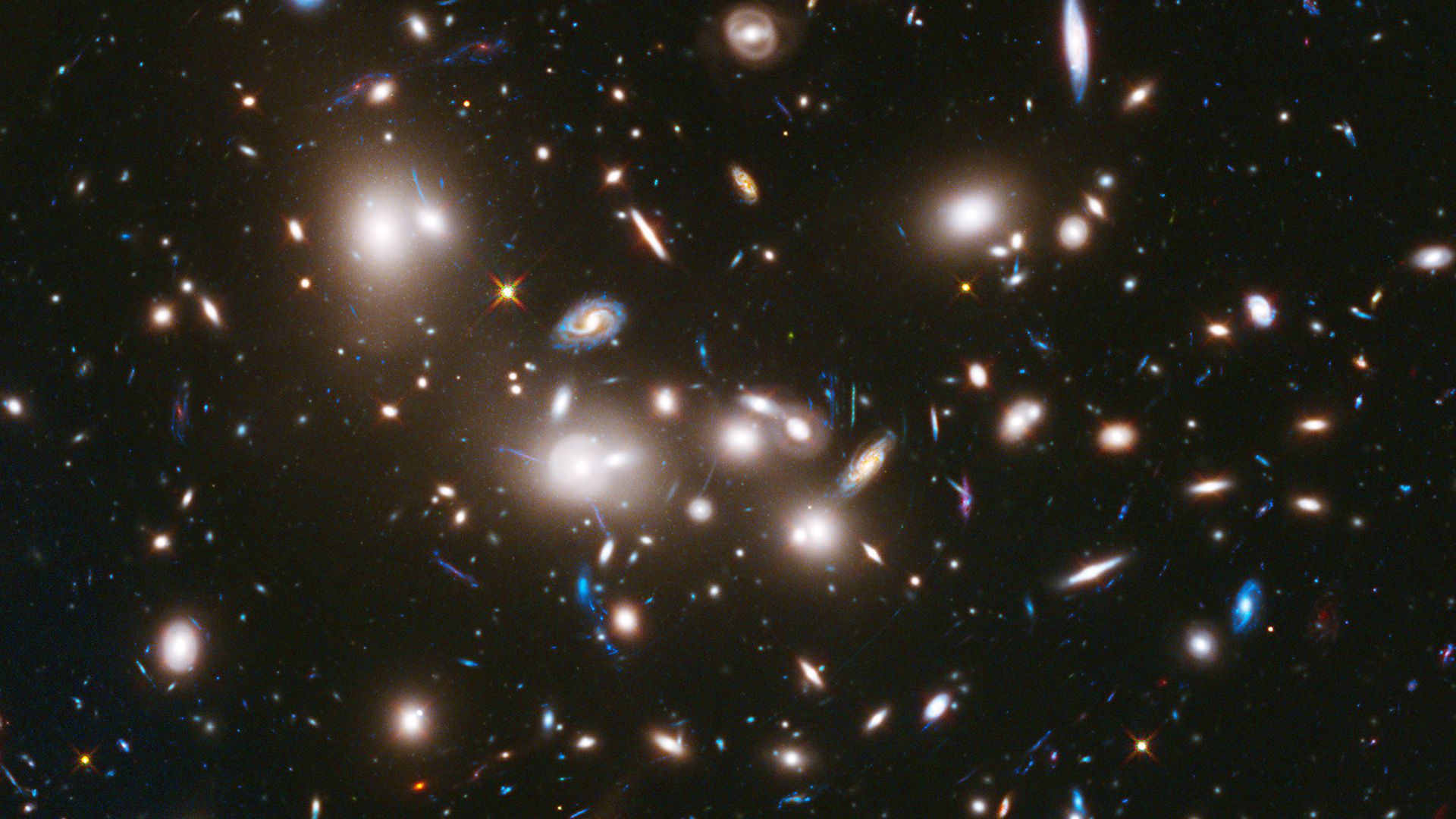
So, have I sufficiently blown your mind?
Good — because it gets even better. Next up, we’ll explore one of the most incredible and critical discoveries of the 21st century: that of dark energy.










Did I blow your mind? 😉