

Okay, I know…weird way to start a post, right? Isn’t this blog supposed to teach science? How can we teach something we don’t know?
This is actually one of the most important concepts in the realm of astrophysics, and even science in general. Yes, this blog aims to teach science. But, fundamentally, learning science means getting comfortable with not knowing.
Science isn’t about knowing. It’s about discovering.
Yes, following the scientific method will eventually lead to answers (in theory). But just as often, it also leads to more questions. That’s the fun part!
And of all the scientific questions in astrophysics, perhaps the most elusive are those about the nature of dark matter (and dark energy, of course!)
So…what could dark matter be?
The indirect evidence for dark matter is quite compelling. But what would really solidify the theory, slam-dunk, is if we could figure out what it’s made of.
What does that mean, though?
Well, let’s first take a look at what ordinary matter is made of, and then we’ll be better poised to ask what dark matter is made of.

Does this look familiar?
I’ve written about atoms before. I’ve described them as the fundamental building block of matter. And that’s true, in the same sense that the cell is the most fundamental building block of life. As I’ve written about before, you can have organic material (generally made of carbon molecule chains), but without cells, you can’t have life.
Without atoms, you can’t have matter — just particle soup, not unlike the conditions of the universe at the beginning of time.
But atoms themselves are made up of even smaller particles…just as cells are made up of organelles.
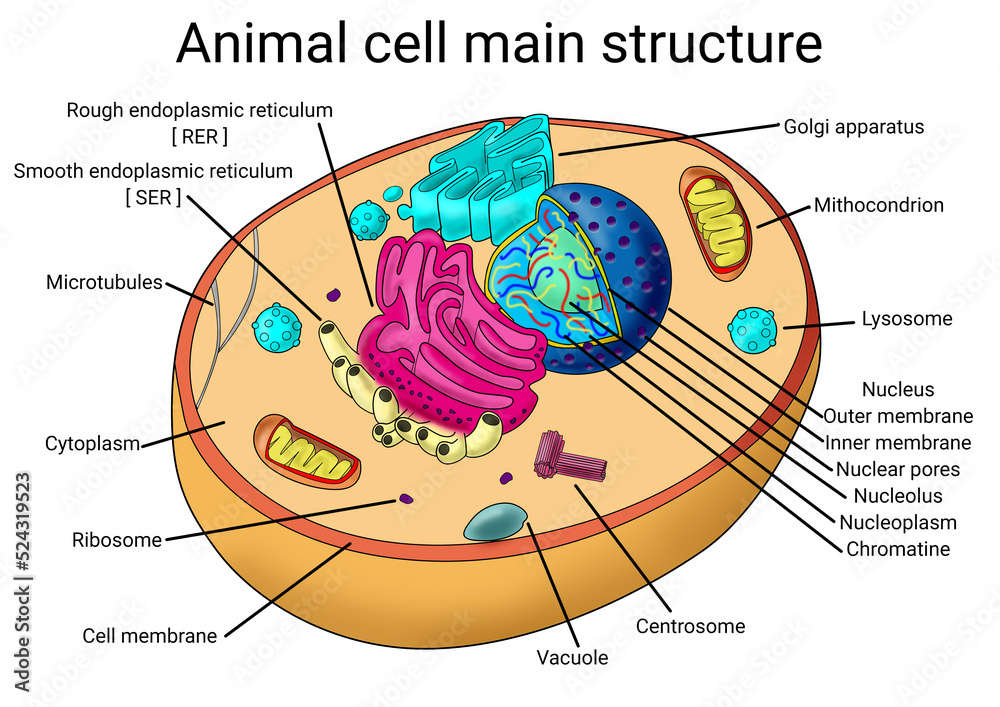
Take a look at that animal cell above. See those colored structures within it? That’s what I’m talking about — organelles.
The word “organelle” might remind you of “organ,” and for good reason: Just as the organs in your body each perform a specific function to keep you alive, the organelles in a cell each work together to keep the cell alive.
And you could go deeper than that. Each organelle is made up of chains of organic molecules. Each molecule is made up of…you guessed it. Atoms!
But what are atoms made up of?
Like the organelles in a cell, the atom is made up of three basic particles: protons, neutrons, and electrons. I’ve covered these before; I won’t go in depth here.
More importantly…protons and neutrons are both part of a class of particles called baryons.

Here’s a diagram showing how all the particles are sorted. As you can see, electrons are part of a different class of particles (called leptons).
But here’s the key…
All matter in the universe is made up of protons and neutrons, and these two particles are types of baryons…
…which means that we can call all matter baryonic matter.
Dark matter, though, is not made up of baryons. And it has yet to be linked to any other particle in what we call the “standard model” of particle physics.
In fact, in the search for dark matter, particle physicists have suggested the existence of theoretical particles — that is, particles that we’re not sure if they really exist.
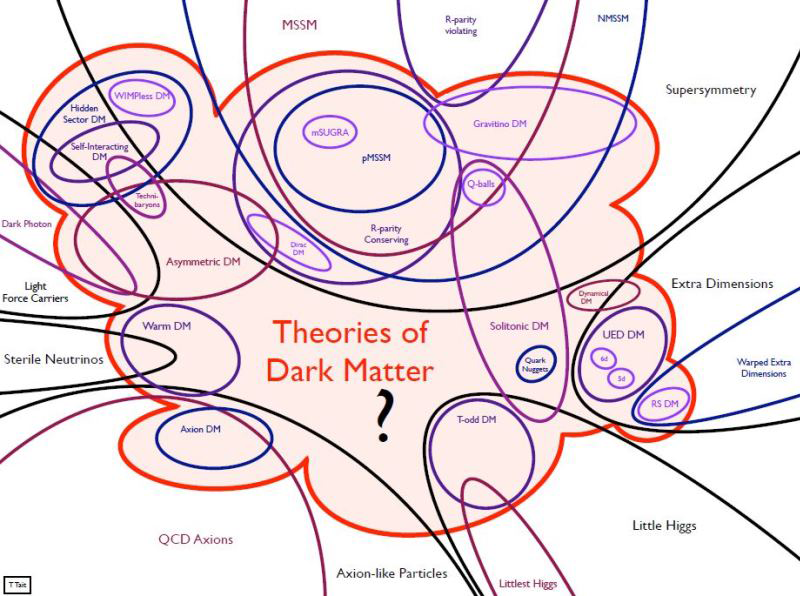
This diagram, published in the September 2024 Scientific American, has quickly become one of my favorite visualizations of the possibilities for dark matter.
Okay, what the actual heck are we looking at?
This is basically a complex version of a Venn diagram. Each circle represents an idea. Where circles overlap, those ideas intersect.
Similarly, where smaller circles are contained within larger circles, you’re looking at a categorization. Think of it like this: a mechanical pencil is a type of pencil. So if you draw a circle for “all pencils,” you can draw a circle inside it for just “mechanical pencils.”
Let’s take a look at an example: the blue circle labeled “Axion DM,” toward the bottom left (the green arrow below).

“DM” stands for “dark matter,” so the graphic means “axion dark matter.” Think of that blue bubble as representing an idea for what dark matter could be: in this case, a theoretical particle called an axion.
Now, notice that the “axion dark matter” bubble is contained completely within a larger black bubble: “Axion-like Particles.”
Makes sense, right? Axions are a type of axion-like particle. But they’re not necessarily the only type. Other particles like axions could fit within that larger black bubble…such as “QCD Axions.”
Note that the purple bubble containing “QCD Axions” is contained completely within the “Axion-like Particles” bubble. But look more closely at where “axion dark matter” intersects with “QCD Axions” (now, the orange arrow):

“Axion dark matter” spills over a little. It’s not contained completely within the “QCD Axions” bubble.
What does that mean?
There are some axion-like particles that are not specifically QCD axions.
The bubble for “axion dark matter” represents all axion-like particles that can explain dark matter. Most of those particles are QCD axions, but some spill over into “axion-like particles” in general.
Now, notice that the “QCD Axions” bubble spills outside of the “Theories of Dark Matter” bubble.
QCD axions are a type of particle that may or may not exist. They are theorized to exist. And if they do exist, they could answer some of the most perplexing questions about the strong nuclear force (one of the fundamental forces of nature).
But…not all QCD axions can explain dark matter.
Many of them can. But there are some possibilities within QCD axion theory that don’t fit what we know about dark matter.
Axions are, in fact, one of the two leading “paradigms” — as particle physicists say — to explain dark matter.
What’s the other leading paradigm, then?

Now, pardon the inadequacy of my image editing software, and…ignore everything that’s not in color.
(I do apologize for the busy image — I tried to draw over the colored lines I wanted to de-emphasize, but Paint.net only takes me so far!)
Now, see the red “bubble” — more like a cloud — in the center?
That bubble encompasses all the ideas for dark matter that we’ve thought up so far, which fit within observations.
Now focus on the orange, blue, and green bubbles around the edge.
Together, those three bubbles make up the WIMP: weakly interacting massive particles. That is, every idea bubble contained within those bubbles fits within the “WIMP” hypothesis.
WIMPs are not a single particle, but a “class” of particle — like “baryons” are a class of particle that includes both protons and neutrons. They are the other leading “paradigm” for dark matter.
But, like with axions, not all WIMPs fit within our observations of dark matter. Only those contained within the “Theories of Dark Matter” cloud do.
So, let’s narrow it down:
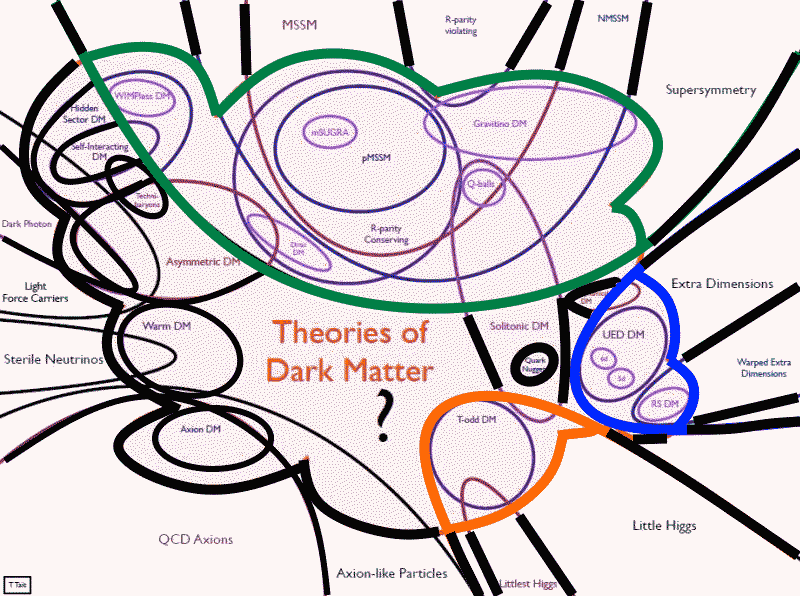
(Again, excuse the inadequacy of my software…)
Contained within the green, blue, and orange bubbles above is every idea that fits the WIMP paradigm of dark matter.
Now let’s include axions, and look at the two leading paradigms:

Bounded within the colored clouds above are the leading ideas we have so far that fit the observations. Green, blue, and orange are WIMPs, and purple is axions.
Now, this bit is critical:
This is all theoretical. And scientists aren’t claiming otherwise.
We don’t know if these particles exist. No one is claiming that dark matter is “solved” — quite the opposite!
There have been many instances on this blog where I have explained how astronomers can have confidence in how a process works based on the mathematical theory. But this is not one of those times.
Even in astronomy, our greatest confidence comes from successfully making observations that support our mathematical conclusions.
When it comes to discovering the particle — or particles — that make up dark matter, there has been no such confirmation. For all that the indirect evidence of dark matter’s existence is solid, its nature still eludes us.
At the end of the day…we don’t know what it is.
And for all we know, it’s completely different from our ideas in this Venn diagram. But here’s the super important bit…
There is no such thing as failure in science. If none of the ideas above yield results — to roughly quote Thomas Edison — we’ve just found a ton of ideas that don’t work.
We will have narrowed down our options, and we’ll be that much closer to solving the mystery.
Next up, we’ll take a step back from the whackiness of cosmology and explore the upcoming Messier Marathon…and after that, I have a special treat for you!
Let’s just say that next post has been a long time coming… 😉











Leave a reply to Jim R Cancel reply